Hungarian food has a branding problem: the one dish everyone knows abroad, goulash, is served in Budapest as a soup, and the stew you were expecting is called something else. This guide sorts that out. It covers 20 Hungarian dishes worth trying in Budapest, what each one actually is, what it cost on real menus in September 2026, and where in the city to eat it.
It’s the hub of our food guides: for guided tastings see the best Budapest food tours and cooking classes, and for where to book a table see our best restaurants in Budapest.
Some links in this guide are affiliate links. They don’t change your price and help keep the site running.
What is Hungarian food known for?#
Hungarian food is known for paprika, slow-cooked meat, sour cream and a serious pastry tradition. The base of most savoury dishes is onions softened in lard or oil, then ground paprika, then meat. Portions are big, soups are a course of their own, and desserts come from the coffee-house culture of the Austro-Hungarian era.
Hungary keeps an official list of national treasures, the Hungarikums. The February 2026 list has 100 entries, and food and drink make up a good share of them: gulyásleves, Baja and Tisza fish soups, lángos, kürtőskalács, Dobos torta, tepertős pogácsa, pálinka, Tokaji aszú, Unicum, fröccs, Egri Bikavér, Pick and Herz winter salami, goose products, and Kalocsa and Szeged paprika (official Hungarikum list, 24 Feb 2026). It’s a useful shopping list. It’s not a complete one: chicken paprikás and stuffed cabbage aren’t on it, and they’re on every menu.
Is Hungarian food spicy?#
Mostly not. Hungarian paprika comes in grades from sweet (édes or csemege) to hot (csípős or erős), and most dishes use the sweet kind for colour and depth. Heat is added at the table from Erős Pista, a hot minced paprika paste, which is a Hungarikum too. Fisherman’s soup is the exception: it can be properly hot.
Gulyás, pörkölt or paprikás: what’s the difference?#
Gulyás is a soup, pörkölt is a stew, and paprikás is a pörkölt finished with sour cream. That one sentence will save you a lot of confused ordering.
| Dish | What it is | Usual meat | Served with | Typical 2026 price |
|---|---|---|---|---|
| Gulyásleves | Brothy paprika soup with potatoes and csipetke noodles, no roux | Beef | Bread | 3,090–4,450 HUF (€8–12) |
| Pörkölt | Thick onion-and-paprika stew, no sour cream | Beef, pork, mutton | Nokedli or potatoes | ~4,000–4,700 HUF (€11–13) |
| Paprikás | Pörkölt with sour cream stirred in | Chicken (usually) | Nokedli | 4,490–6,650 HUF (€12–18) |
Prices from the menus of Gettó Gulyás, Menza, Frici Papa, Gundel and Kiosk, checked September 2026.
Verdict: order gulyás as a starter or a light lunch, and pörkölt or paprikás as the main. If you want what your grandmother called goulash, ask for marhapörkölt (beef pörkölt).
The 20 Hungarian dishes to try in Budapest#
Here’s the full list with the best places to try each one. Every venue below had an active menu or official page in September 2026.
| # | Dish | Type | Where to try it in Budapest | Price seen (Sep 2026) |
|---|---|---|---|---|
| 1 | Gulyásleves | Soup | Gettó Gulyás, Menza, Frici Papa | 3,090–3,599 HUF |
| 2 | Pörkölt | Main | Gettó Gulyás, Frici Papa | 3,999–4,690 HUF |
| 3 | Paprikás csirke | Main | Menza, Gettó Gulyás, Gundel | 4,490–6,650 HUF |
| 4 | Halászlé | Soup | Gundel | 3,500 HUF |
| 5 | Töltött káposzta | Main | Great Market Hall stalls, winter menus | varies |
| 6 | Lecsó | Main | Gettó Gulyás | 4,190 HUF |
| 7 | Főzelék | Veg stew | Frici Papa | 1,199–1,299 HUF |
| 8 | Rakott krumpli | Bake | Frici Papa | 3,499 HUF |
| 9 | Hortobágyi palacsinta | Starter | Gettó Gulyás, Menza | 2,990–3,990 HUF |
| 10 | Sólet | Main | Kádár Étkezde | see menu |
| 11 | Libamáj | Starter | Gundel | 7,000 HUF (pâté) |
| 12 | Mangalica | Main | Gundel | 8,400 HUF (schnitzel) |
| 13 | Kolbász & téliszalámi | Charcuterie | Great Market Hall butchers | by weight |
| 14 | Lángos | Street food | Retró Lángos, Great Market Hall | 2,490–3,490 HUF |
| 15 | Tepertős pogácsa | Snack | Bakeries (pékség) | cheap |
| 16 | Kürtőskalács | Street sweet | Molnár’s (Váci utca) | see stand |
| 17 | Dobos torta | Cake | Cafés and cukrászdas | varies |
| 18 | Somlói galuska | Dessert | Frici Papa, Gettó Gulyás, Menza, Gundel | 1,999–3,325 HUF |
| 19 | Gundel palacsinta | Dessert | Frici Papa, Gundel | 1,999–3,325 HUF |
| 20 | Rétes | Pastry | Cafés, bakeries | varies |
Prices from each venue’s own menu (Frici Papa, Menza, Gettó Gulyás, Gundel, Retró Lángos), checked September 2026. € ≈ HUF ÷ 365.
1. Gulyásleves (goulash soup)#
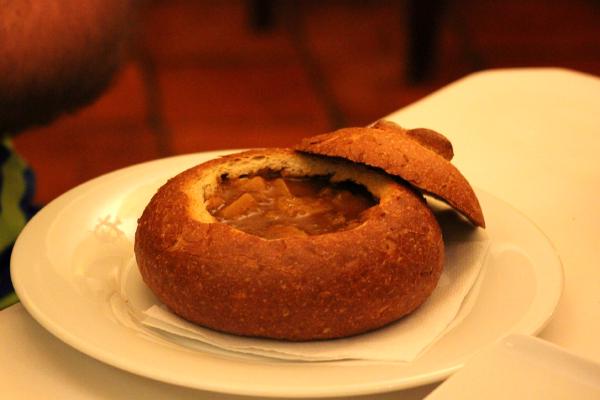
Gulyás is Hungary’s national dish: a paprika-red beef soup with plenty of broth, onions, diced potatoes and csipetke, tiny pinched noodles, made without a roux (Hungarikum entry). The name comes from the gulyás, the cattle herdsmen who cooked it in a kettle on the plain. It became a Hungarikum in 2017. At lunch a bowl with bread is a meal. Gettó Gulyás in District VII charges 3,090 HUF (about €8), Menza 3,590 and Kiosk, by the Elisabeth Bridge, 4,450.
2. Pörkölt (paprika stew)#
Pörkölt is the dish the rest of the world calls goulash: meat stewed slowly in onions and paprika until the sauce is thick and glossy. Beef (marhapörkölt) is the standard; pork and mutton versions are common, and the Karcag mutton pörkölt is a Hungarikum in its own right. Gettó Gulyás is built around it (beef 4,690 HUF). At Frici Papa it’s 3,999 HUF before you choose a side.
3. Paprikás csirke (chicken paprikash)#
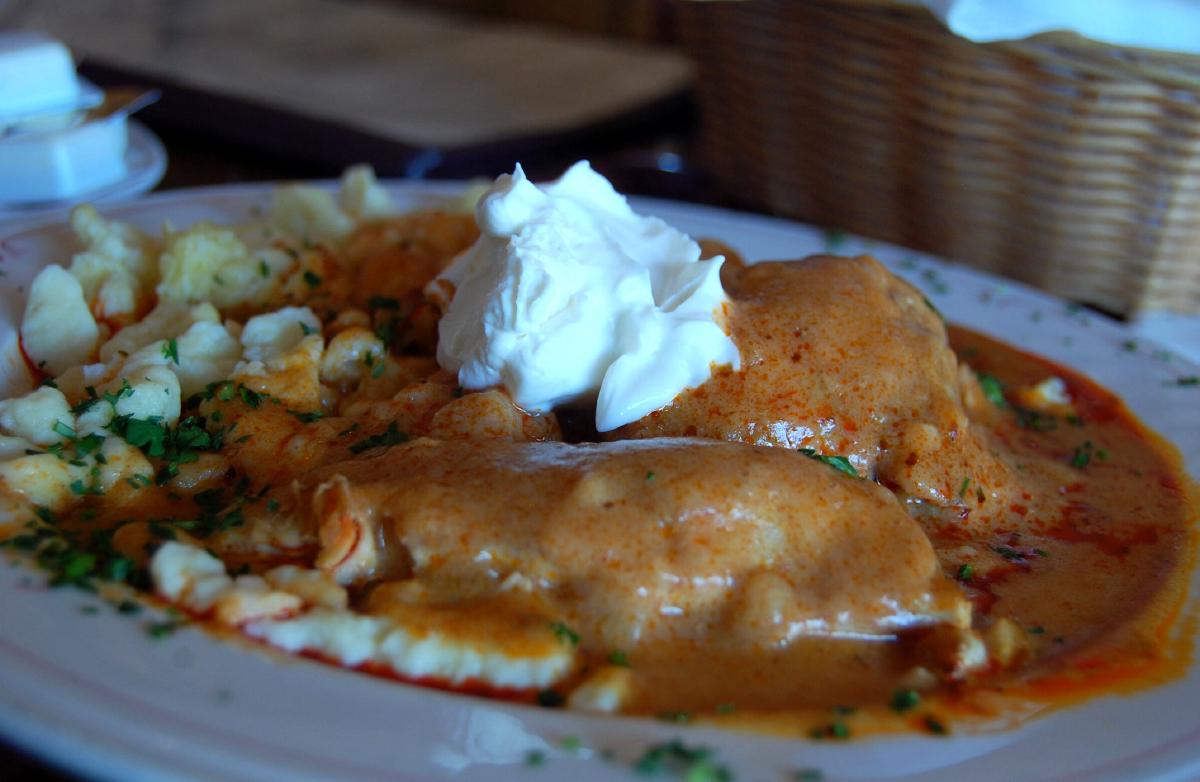
Chicken paprikás is pörkölt made with chicken and finished with sour cream, served with nokedli, soft egg dumplings like spätzle. It’s the most comforting plate on the list and the one most people remember. Gettó Gulyás charges 4,490 HUF, Menza on Liszt Ferenc tér 4,890 and Gundel 6,650.
4. Halászlé (fisherman’s soup)#
Halászlé is a fiery red river-fish soup, traditionally made with carp. There are two regional styles and both are Hungarikums: the Bajai version, usually served with pasta in it, and the Tiszai (Szeged-area) version, whose base is made from white fish plus the carp’s head and tail. It’s Christmas Eve food for many families and a love-it-or-leave-it dish for visitors because of the bones. Gundel’s version costs 3,500 HUF.
5. Töltött káposzta (stuffed cabbage)#
Töltött káposzta is sour-cabbage leaves rolled around minced pork and rice, braised with sauerkraut and smoked meat and topped with sour cream. It’s a winter dish: you’ll find it at the Great Market Hall’s upstairs stalls and at the Christmas markets, where a portion cost 5,500–6,700 HUF in 2025. Its fermented base, Vecsés sauerkraut, became a Hungarikum in February 2026.
6. Lecsó#
Lecsó is Hungary’s ratatouille: peppers, tomatoes and onions stewed in paprika, often with sausage and eggs stirred in. It’s a late-summer staple at home and a good vegetarian option if you skip the sausage. Gettó Gulyás serves it with sausage and egg for 4,190 HUF.
7. Főzelék#
Főzelék is a thick vegetable stew, somewhere between a soup and a purée, made from peas, lentils, potatoes, marrow (tökfőzelék) or spinach and usually topped with a fried egg or a meatball. It’s what Hungarians actually eat for a weekday lunch, and it’s the cheapest hot meal in this guide: 1,199–1,299 HUF at Frici Papa.
8. Rakott krumpli#
Rakott krumpli is layered potatoes, sliced hard-boiled eggs and smoked sausage baked under sour cream. It’s filling, cheap and not photogenic. Frici Papa serves it for 3,499 HUF.
9. Hortobágyi palacsinta#
Hortobágyi palacsinta is a savoury pancake filled with minced meat pörkölt, folded into a parcel and baked in a paprika-sour-cream sauce. It’s a starter on paper and a main in practice. Gettó Gulyás charges 2,990 HUF and Menza 3,990.
10. Sólet#
Sólet is the Hungarian Jewish slow-cooked bean stew, traditionally prepared on Friday and eaten on the Sabbath, usually with smoked meat or goose and an egg. The place to try it is Kádár Étkezde on Klauzál tér (District VII), a small lunch canteen that still has it on the menu. It’s open daily 8:30–17:00, with lunch from 11:00 to 16:30 (kadaretkezde.hu). The Jewish Quarter around it is covered in our Dohány Synagogue and Jewish Quarter guide.
11. Libamáj (goose liver)#
Hungary is one of Europe’s big producers of goose liver, and products from fattened geese are on the Hungarikum list. You’ll see it as pâté, as a terrine or pan-fried with apple or Tokaji. Gundel lists a goose-liver pâté at 7,000 HUF. If you have ethical reservations about foie gras, this is the dish to skip.
12. Mangalica pork#
Mangalica is a curly-haired Hungarian pig breed with fatty, deeply flavoured meat, the country’s answer to Iberian pork. Restaurants serve it as a chop, a schnitzel or cured ham. At Gundel a mangalica schnitzel costs 8,400 HUF, and charcuterie counters at the Great Market Hall sell mangalica sausage and bacon.
13. Kolbász and téliszalámi#
Paprika sausage (kolbász) and winter salami (téliszalámi) are Hungary’s great charcuterie. Pick’s Szeged winter salami, a noble-mould salami made to a 19th-century recipe, and Herz’s are both Hungarikums, as are the Csabai and Gyulai sausages. Buy them at the butchers on the ground floor of the Great Market Hall, open Monday–Friday 6:00–18:00, Saturday 6:00–16:00 and now also Sunday 10:00–16:00. They travel well.
14. Lángos#
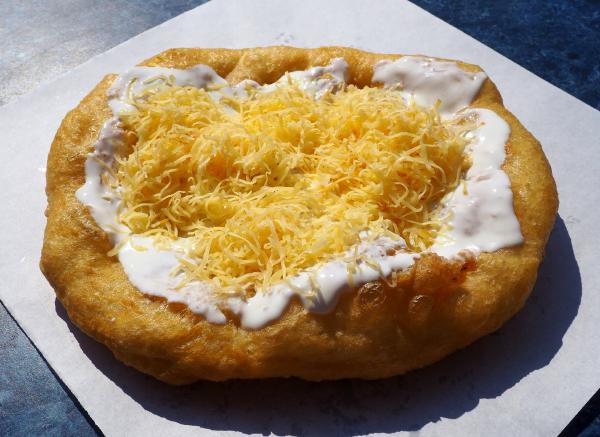
Lángos is a disc of deep-fried yeast dough, crisp outside and soft inside, rubbed with garlic and piled with sour cream and grated cheese. It became a Hungarikum in 2023. Retró Lángos on Vécsey utca (District V) is the easy central stop: 2,490 HUF plain, 2,990 with sour cream or cheese, 3,490 with both. The Great Market Hall’s upper gallery is the other classic. One is a meal; two is a mistake you’ll make only once.
15. Tepertős pogácsa#
Pogácsa are small savoury scones sold in every bakery. The one on the Hungarikum list (since February 2026) is tepertős pogácsa, made with crushed pork crackling. Cheese (sajtos) pogácsa is the milder alternative. Buy a bag at any pékség for the train.
16. Kürtőskalács (chimney cake)#
Kürtőskalács is sweet dough wound around a wooden spit, baked over heat until the sugar caramelises, then rolled in cinnamon, walnuts or cocoa. It’s originally from the Székely region of Transylvania and it’s a Hungarikum. Molnár’s Kürtőskalács at Váci utca 31 bakes them fresh, and a Molnár’s chimney cake is included in the Budapest Card Plus. If you’d rather make one yourself, this workshop is the best-reviewed food experience in the city:
Traditional Chimney Cake (Kürtőskalács) Workshop
Roll, wrap and bake your own chimney cake in a studio in District IX, with toppings and a coffee or tea. Rated 4.9 from 1,479 reviews. Good with kids, and on a rainy afternoon.
View Tour →17. Dobos torta#
Dobos torta is five thin sponge layers filled with chocolate buttercream and topped with a hard caramel disc. The confectioner József C. Dobos created it in 1884, presented it at the 1885 National General Exhibition in Budapest, and gave the recipe to the confectioners’ guild in 1906 (Hungarikum entry). It’s on the counter of most cukrászdas (pastry shops). For a slice with some history, the Buda Castle walk with a royal cake tasting includes one.
18. Somlói galuska#
Somlói galuska is sponge cake soaked in rum syrup, layered with walnuts, raisins and vanilla cream, covered in chocolate sauce and whipped cream. It was created at Gundel in the late 1950s and was a hit at the 1958 Brussels World Expo (Gundel). Frici Papa charges 1,999 HUF, Gettó Gulyás 2,590, Menza 2,890 and Gundel 3,325.
19. Gundel palacsinta#
Gundel palacsinta is a thin pancake filled with rum-soaked walnuts and raisins and served under dark chocolate sauce, sometimes flambéed. According to Gundel itself, it began in 1940 as the “Márai palacsinta”, from the writer Sándor Márai’s family recipe, and was renamed after the Márais emigrated (Gundel). It costs 3,325 HUF at Gundel (plus 1,400 flambéed) or 1,999 at Frici Papa.
20. Rétes (strudel)#
Rétes is paper-thin stretched pastry rolled around apple, sour cherry, poppy seed or sweet túró (curd cheese). Hungarian bakers stretch the dough by hand over a table until you can read through it, which is harder than it sounds. Cafés and bakeries sell it by the slice. Or learn it: the Hungarian strudel class teaches the stretch in 2.5 hours.
Bonus, from the supermarket: Túró Rudi, a chocolate-coated bar of sweet curd cheese in a red polka-dot wrapper, sold in the chiller of every grocery. It costs very little and it’s the one snack Hungarians abroad miss most.
What should you drink in Hungary?#
Drink pálinka, Unicum, a fröccs, Egri Bikavér and Tokaji. Each one is protected by law or listed as a Hungarikum, and all of them are easy to find in central Budapest.
| Drink | What it is | Price seen (Sep 2026) | Try it at |
|---|---|---|---|
| Pálinka | Fruit brandy (plum, apricot, pear, cherry), 37.5–86% ABV | 2,390–3,390 HUF per 4 cl | Any bar or restaurant |
| Unicum | Zwack’s bitter herbal liqueur | 1,490–2,650 HUF | Bars; the House of Unicum |
| Fröccs | Wine mixed with soda water | Kisfröccs 850 HUF | Any bar |
| Egri Bikavér | Red blend from Eger | by the glass | Wine bars |
| Tokaji aszú | Sweet wine from botrytised grapes | by the glass | Wine bars |
Pálinka, Unicum and fröccs prices from the Menza and Kiosk drinks menus, September 2026.
Pálinka may be called pálinka only if it’s made entirely from fruit grown in Hungary and is mashed, distilled, aged and bottled in the country, with no added sugar, flavourings or concentrates (Nébih). The strength runs from 37.5% up. Sip it; don’t shoot it. Toast with Egészségedre! (“to your health”).
Unicum is a dark herbal bitter made by the Zwack family to a recipe that the company dates to 1790, with more than 40 herbs, aged in oak casks. The House of Unicum at Dandár utca 1 (District IX) runs visits Monday to Saturday, 10:00–17:00; the adult ticket was 4,200 HUF when we checked (zwackunicum.hu).
Fröccs is the Hungarian way to drink wine in summer, and it has its own vocabulary. A kisfröccs is 1 dl wine and 1 dl soda, a nagyfröccs 2 dl wine and 1 dl soda, a hosszúlépés 1 dl wine and 2 dl soda, and a házmester 3 dl wine and 2 dl soda. At Menza a kisfröccs cost 850 HUF in September 2026.
Egri Bikavér (“Bull’s Blood of Eger”) is a blended red built on Kékfrankos, and it’s best tasted at the source on an Eger day trip. Tokaji aszú is the famous sweet wine: since the 2013 rule change it must have at least 120 g/l of residual sugar, and the old 3- and 4-puttonyos grades were dropped. Wine bars pour both by the glass.
One custom you’ll hear about: many Hungarians don’t clink beer glasses, a habit linked to the execution of the 13 Martyrs of Arad in October 1849. Historians call the story a legend without a written source, but plenty of people still observe it, so follow the table’s lead. Clinking wine and pálinka glasses is fine.
Where should you eat Hungarian food in Budapest?#
For traditional Hungarian food at fair prices, eat at a kifőzde or étkezde (simple lunch canteens) or a modern bistro that cooks the classics properly. These are the places we used for the prices above, all with current menus in September 2026:
| Place | Address | Best for | Price level | Catch |
|---|---|---|---|---|
| Frici Papa Kifőzdéje | Király utca 55, District VII | Cheap classics, főzelék | € | Closed Sundays; no frills |
| Kádár Étkezde | Klauzál tér 9, District VII | Sólet, home cooking | € | Lunch only, closes 17:00 |
| Gettó Gulyás | Wesselényi utca 18, District VII | Pörkölt and paprikás | €€ | Book for dinner |
| Menza | Liszt Ferenc tér 2, District VI | Classics in a retro dining room, lunch menu | €€ | Busy square, touristy at night |
| Gundel | City Park, District XIV | The famous desserts, a special night | €€€ | 15% service charge on the bill |
| Retró Lángos | Vécsey utca 3, District V | Lángos | € | Takeaway counter |
| Great Market Hall | Vámház körút 1–3, District IX | Lángos, stuffed cabbage, salami to take home | €–€€ | Upstairs stalls are touristy; closed public holidays |
Verdict: for one Hungarian meal, go to Gettó Gulyás for dinner (book ahead). For the best value, have lunch at Frici Papa. Menza’s weekday lunch menu (napi menü) cost 2,890 HUF in September 2026. Most Budapest restaurants serve a set lunch like this on weekdays, and it’s the cheapest way to eat well in the city.
For a full list of restaurants by budget, including fine dining and the grand cafés, see our guide to the best restaurants in Budapest. For eating in the Jewish Quarter after dark, our ruin bars guide covers Karaván’s food trucks next to Szimpla.
Is a food tour the best way to try Hungarian food?#
A food tour is the fastest way to try a dozen of these dishes in one go, and it’s worth it early in a trip, when it teaches you what to order for the rest of the week. It’s not the cheapest way: the Great Market Hall, a lángos and one lunch at Frici Papa cover much of the same ground for a fraction of the price.
Food Tour Market to Tavern: 12+ Tasters & Wines
Foodapest’s three-hour walk starts at the Great Market Hall and takes in lángos, salami, pálinka, a family bakery and a sit-down tavern course with wine. It’s our top-rated food tour and the best single introduction to the dishes above. Foodapest also sells it on its own site for a little less, so compare both.
Other good options: the Budapest food tour with a market walk and 20+ tastings (from €79, 4.9 from 60 reviews) covers goulash, lángos, chimney cake, cold cuts and pálinka. Foodapest’s cooking class with a market walk (from €90) teaches you to cook three of the classics. Every option is compared in our Budapest food tours guide.
Who should skip the heavy classics?#
If you’re vegetarian, Hungarian home cooking is harder going than it looks, because lard, bacon and meat stock turn up in unexpected places. Főzelék, lecsó without sausage, lángos, túrós csusza and all the desserts are your friends; ask whether the főzelék is made with meat stock. Vegans should lean on modern bistros rather than étkezdes. And if you’re in Budapest for a single day, don’t queue at the most famous names: one bowl of gulyás, one lángos and a slice of cake will do. Our 3-day Budapest itinerary fits a market lunch and a proper Hungarian dinner into the plan.
In December, the markets are the easiest place to graze through the list: see our Budapest Christmas markets guide for what the stalls sell. For everything else to do between meals, see the best things to do in Budapest.
FAQ#
What is the national dish of Hungary?#
Gulyás (gulyásleves) is Hungary’s national dish: a paprika-red beef soup with onions, potatoes and small pinched noodles called csipetke, made without a roux. It has been on Hungary’s official Hungarikum list since 2017. In central Budapest restaurants a bowl cost about 3,100 to 4,500 HUF in September 2026.
What is goulash in Hungary?#
In Hungary, gulyás is a soup, not a stew. The thick paprika stew that most other countries call goulash is pörkölt, and if sour cream is stirred in it becomes paprikás. Order gulyásleves for the soup and marhapörkölt for the beef stew.
Is Hungarian food spicy?#
Mostly not. Hungarian cooking uses a lot of paprika, but usually the sweet kind (édes), which adds colour and flavour rather than heat. The hot kind (csípős or erős) and the Erős Pista chilli paste on restaurant tables let you add heat yourself. Fisherman’s soup, halászlé, is the dish most likely to be properly hot.
What is the most famous Hungarian dessert?#
Dobos torta is the most famous: five thin sponge layers with chocolate buttercream under a hard caramel top, created by the confectioner József C. Dobos in 1884 and presented at the 1885 Budapest exhibition. Somlói galuska and Gundel palacsinta are close rivals, and kürtőskalács (chimney cake) is the favourite street sweet.
What is lángos?#
Lángos is a disc of deep-fried yeast dough, crisp outside and soft inside, usually topped with garlic, sour cream and grated cheese. It is a Hungarikum since 2023. At Retró Lángos in central Budapest a plain one cost 2,490 HUF and one with both sour cream and cheese 3,490 HUF in September 2026.
How much does goulash cost in Budapest?#
A bowl of gulyás soup cost 3,090 to 4,450 HUF (about 8 to 12 euros) at central Budapest restaurants in September 2026, according to their own menus: 3,090 at Gettó Gulyás, about 3,600 at Menza and Frici Papa, 3,675 at Gundel and 4,450 at Kiosk. A daily lunch menu with soup and a main can cost less than that.
What should you drink in Hungary?#
Try pálinka (fruit brandy made only from Hungarian fruit), Unicum (Zwack’s herbal liqueur), a fröccs (wine and soda water), Egri Bikavér (the red blend from Eger) and a glass of sweet Tokaji aszú. All except fröccs’s soda are protected or listed as Hungarikums, and a kisfröccs cost about 850 HUF in a central bar in September 2026.
Do Budapest restaurants add a service charge?#
Many do. A service charge of up to 15 percent can be printed on the bill, and restaurants such as Menza and Gundel say so on their menus. If it is on the receipt you do not need to tip again; if it is not, 10 percent is normal for good service.
Last verified: 19 October 2026. Prices and timetables change, so confirm with the operator before booking.