Budapest public transport is cheap, frequent and slightly more complicated than it needs to be. The metro takes a tap of your bank card, the tram next to it doesn’t, and a single ticket stops being valid the moment you change from a bus to a tram. None of that is hard once you know it, and most of the guides ranking for this still quote the old prices.
This guide covers the 2026 fares from BKK, the transport authority, plus which ticket fits which trip, how validation works and the lines worth riding for the view. If you’re still building your plan, our 3-day Budapest itinerary tells you which line to take each day.
Some links in this guide are affiliate links. They don’t change your price and help keep the site running.
How does Budapest public transport work?#
Budapest public transport is one network run by BKK: four metro lines, trams, buses, trolleybuses and the HÉV suburban railway all take the same tickets inside the city boundary. The exceptions are the 100E airport bus, the Buda Castle Funicular and the tourist boats, which have their own fares.
| Mode | Lines you’ll use | Good for | Tap your bank card? |
|---|---|---|---|
| Metro | M1 (the 1896 line under Andrássy út), M2, M3, M4 | Crossing the city fast | Yes (Pay&GO) |
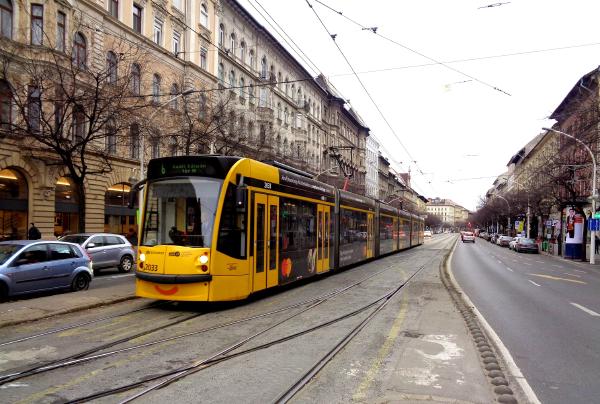
| Tram | 2 (Danube bank), 4 and 6 (Grand Boulevard) | Sightseeing, short hops | No |
| Bus | 16 (Castle Hill), 100E and 200E (airport) | The Castle, the airport | 100E only |
| HÉV | H5 to Szentendre | Day trips | No |
| Boat | D14 ferry (far south); BKV tourist loop | Not really transport | No |
Verdict: for a first visit you’ll mostly use the metro, tram 2, trams 4 and 6, and bus 16. The rest is optional.
How much are Budapest public transport tickets in 2026?#
A single ticket on Budapest public transport costs 500 HUF (about €1) bought in advance, and a 72-hour travelcard costs 5,750 HUF (about €16), according to BKK’s price list as of October 2026. These are the fares a visitor actually needs:
| Ticket | Price | What it covers | The catch |
|---|---|---|---|
| Single ticket | 500 HUF (€1) | One trip on one vehicle, 80 min | No changes except metro to metro |
| Single bought on board | 700 HUF (€2) | Same as above | Only on vehicles with the pictogram |
| Block of 10 singles | 4,500 HUF (€12) | Ten singles at 450 HUF each | Paper, needs validating |
| 30-minute ticket | 600 HUF (€2) | Unlimited changes for 30 min | BudapestGO app only |
| 90-minute ticket | 850 HUF (€2) | Unlimited changes for 90 min | BudapestGO app only |
| 24-hour travelcard | 2,750 HUF (€8) | Everything except the 100E | Mobile version needs ID |
| 72-hour travelcard | 5,750 HUF (€16) | Everything except the 100E | Mobile version needs ID |
| 100E airport ticket | 2,500 HUF (€7) | The 100E only | Travelcards aren’t valid on it |
Prices checked October 2026 on the official BKK price list. Euro amounts are approximate.
There’s no 48-hour, weekly or 15-day travelcard, whatever older blogs say. The next step up from 72 hours is the monthly Budapest-pass (8,950 HUF, about €25), which is only worth it if you’re staying around two weeks.
Travelcards also cover the HÉV and second-class MÁV trains within the city boundary, plus the D14 ferry (BKK).
Which Budapest ticket or pass should you buy?#
The 24-hour travelcard pays for itself on the sixth ride of the day, and the 72-hour travelcard on the twelfth ride over three days. Below that, singles are cheaper. Here’s how that works out for typical trips:
| Your trip | Buy this | Why |
|---|---|---|
| A weekend based in District V or VII, mostly walking | Singles, or Pay&GO taps on the metro | You’ll ride 2–3 times a day |
| Three full sightseeing days | 72-hour travelcard | 5,750 HUF beats 12+ singles, and you stop thinking about changes |
| One busy day with the Castle, baths and a night out | 24-hour travelcard | Six rides and you’re already ahead |
| Short hops with changes, phone in hand | 30- or 90-minute app ticket | One ticket covers bus to tram to metro |
| Three days of museums as well | Budapest Card | Only if the free entries add up (see below) |
Verdict: buy the 72-hour travelcard for a classic three-day trip. Changing lines on singles adds up faster than you’d think, and a single doesn’t let you change from the 200E to the metro, or from bus 16 to tram 2.
Can you pay by contactless card on Budapest public transport?#
Contactless payment on Budapest public transport works only on the four metro lines and the 100E airport bus, through BKK’s Budapest Pay&GO system. Tap a contactless bank card, phone or watch on the reader at the metro entrance and it buys and validates a single ticket in one step, at the normal price. All four metro lines have taken it since 22 April 2026 (BKK).
What it doesn’t do:
- Trams, trolleybuses and ordinary buses have no tap-to-pay readers. The full network rollout is planned from 2028.
- One tap is one single ticket. BKK mentions no daily cap, so tap six times in a day and a 24-hour travelcard would have been cheaper.
- Inspectors check the card you tapped. Hold the same card or phone to their device; it doesn’t charge you again.
On the 100E, one tap can buy up to five airport tickets for a group. Since 8 September 2026, drivers on buses 105, 210 and 210B also take cards for the 700 HUF on-board ticket. BKK says the 200E airport bus follows in mid-October and bus 16 in early 2027 (BKK news).
For everything else, use the BudapestGO app (free, but you register to buy) or the ticket machines, which take cash and bank cards. App travelcards become valid two minutes after purchase, so don’t buy one with the tram doors already closing.
How do you validate a ticket in Budapest?#
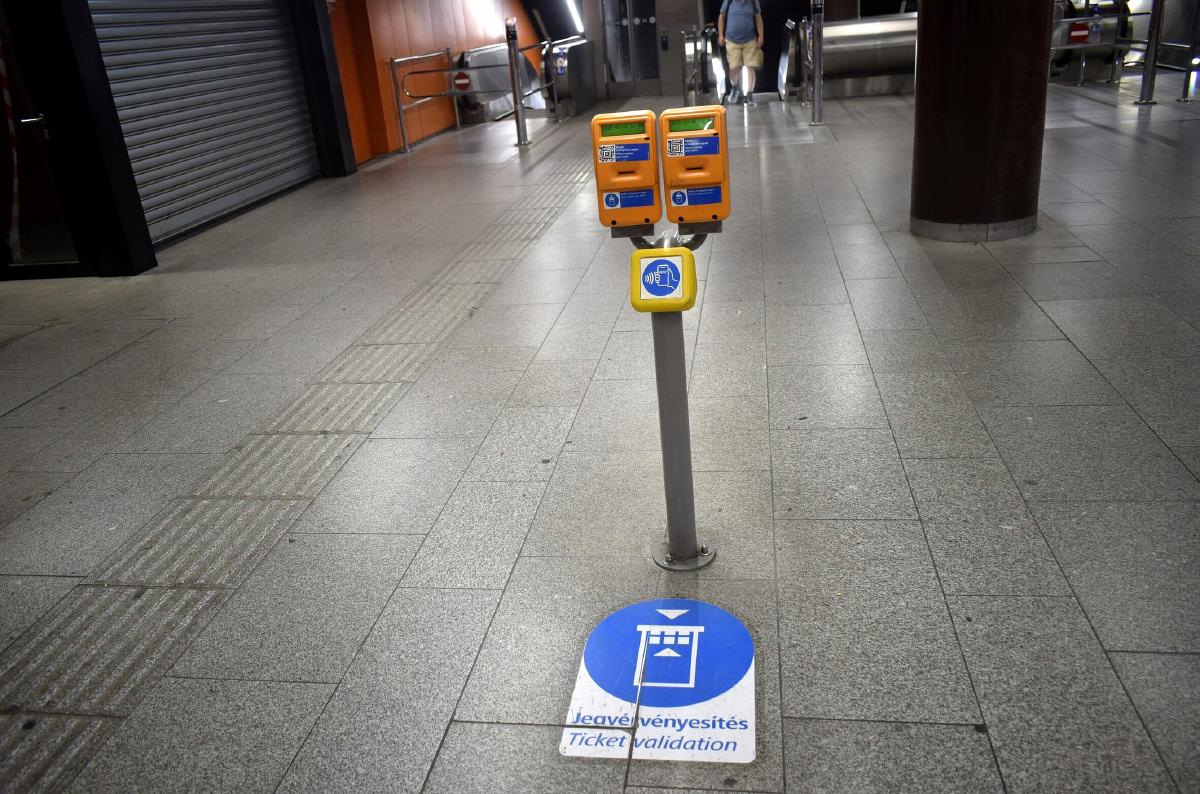
You validate a paper single ticket at the metro entrance before you go down, or straight after boarding a tram or bus, before it moves. The machines are either the red manual punches (push the ticket in and pull the black frame towards you) or the orange and yellow electronic ones (BKK’s guide for tourists).
- Paper travelcards need no validation. They’re printed with the start date and time, and you just show them.
- App tickets are validated by holding your phone to the QR or NFC sticker at the metro entrance or by the front door. Mobile travelcards are personal: carry the passport or ID you registered with.
- Some buses are front-door boarding only, and at night that applies to every non-articulated bus. Show your ticket or pass at the validator by the driver.
- Single tickets last 80 minutes (120 minutes on night services), and on the metro you can change lines in one direction only.
Is tram 2 worth riding as a sightseeing line?#
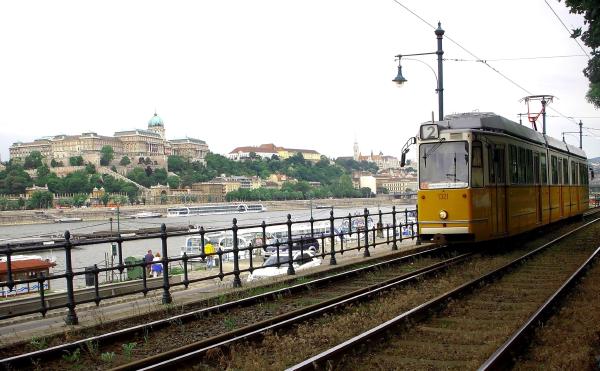
Tram 2 is the best-value sightseeing ride in Budapest: it runs along the Pest bank of the Danube between Jászai Mari tér and Közvágóhíd, past the Parliament, the Chain Bridge and the full view of Buda Castle, for the price of one 500 HUF single ticket. BKV, which runs the trams, calls it one of its most famous lines (BKV thematic routes).
The stops that matter, north to south:
- Kossuth Lajos tér and Országház, látogatóközpont: the Parliament (Országház) and its visitor centre
- Széchenyi István tér: the Chain Bridge, Gresham Palace, Buda Castle across the river
- Vigadó tér: the Little Princess statue and the cruise docks
- Március 15. tér: Elisabeth Bridge and Gellért Hill
- Fővám tér: the Great Market Hall and the bottom of Váci utca
Heading south, the river is on your right, so sit on that side. Trams run every 5–11 minutes by day. At dusk it’s a cheaper view than most of the cruises, although the cruises do have the drinks.
How do you get up to Buda Castle by public transport?#
The easiest way up to Buda Castle by public transport is bus 16, which runs from Deák Ferenc tér across the river and up to the Castle District on an ordinary ticket or travelcard. From Clark Ádám tér, at the Buda end of the bridge, it’s about three minutes to the Halászbástya stop by Fisherman’s Bastion.
The Sikló funicular is the scenic alternative, but no BKK ticket or pass is valid on it. It costs 4,500 HUF (€12) one way or 5,500 HUF (€15) return for adults, runs 8:00–22:00, and is closed 5–16 October 2026 for maintenance, plus Mondays in odd-numbered weeks (BKK funicular page). For walking routes and what to see at the top, see our Buda Castle and Fisherman’s Bastion guide.
Can you take a boat on Budapest public transport?#
Not usefully, as of October 2026. BKK’s city-centre commuter boats (D11 and D12) aren’t running, and the only regular BKK boat line is the D14 car ferry in the far south of the city, between Csepel and Soroksár. The 24- and 72-hour travelcards do cover it.
BKV’s separate sightseeing loop (Kossuth Lajos tér, Margaret Island, Batthyány tér, Várkert Bazár and Petőfi tér) has its own ticket, and is temporarily suspended because of low Danube water as of 1 October 2026 (BKV boats). If you want to see the city from the water, a commercial cruise is the reliable option: the one-hour Historical Cruise with a welcome drink on GetYourGuide leaves from Dock 10, and our Budapest river cruise guide compares the rest.
Can you take the HÉV to Szentendre?#
Yes. The H5 HÉV runs from Batthyány tér to Szentendre, and your Budapest ticket or travelcard covers it as far as Békásmegyer, the last station inside the city. For the section beyond, you need an extra ticket, bought before boarding where there’s a sales point (MÁV HÉV fares). Our Danube Bend and Szentendre guide has the exact fares and the cheapest day ticket for the trip.
Does Budapest public transport run at night?#
Budapest public transport runs all night, but the metro doesn’t. Since June 2025 the last M2, M3 and M4 trains leave around midnight Sunday to Thursday and around 1:00 on Friday and Saturday nights (BKK).
After that:
- Tram 6 runs 24 hours a day on the Grand Boulevard, past Oktogon and Blaha Lujza tér.
- Night buses are numbered in the 900s. The network was reorganised in July 2026, so older line lists are out of date. Plan in the BudapestGO app (BKK night services).
- On-board singles cost 700 HUF on night buses. Singles are valid for 120 minutes at night.
- The 100E and 200E airport buses run all night.
Taxis, Bolt and Uber run all night at the same regulated fare as by day. Our Budapest at night guide covers the late options.
Is the Budapest Card worth it for public transport?#
The Budapest Card is not worth buying for public transport alone: the 72-hour card costs 29,990 HUF (about €82) and the 72-hour travelcard 5,750 HUF (about €16), with the same transport cover. The extra 24,000 HUF only comes back if you use the free museums, the included cruise and the bath discounts.
| Card | Price | Transport | Includes the 100E? |
|---|---|---|---|
| 24-hour Budapest Card | 17,990 HUF (€49) | Unlimited BKK | No |
| 48-hour | 23,990 HUF (€66) | Unlimited BKK | No |
| 72-hour | 29,990 HUF (€82) | Unlimited BKK | No |
| 72-hour Flexi | 27,990 HUF (€77) | Unlimited BKK | One of its five picks |
| 72-hour Plus | 39,990 HUF (€110) | Unlimited BKK | One round trip |
| 96-hour | 38,990 HUF (€107) | Unlimited BKK | No |
Prices checked October 2026 on the BKK Budapest Card page.
Verdict: if you’re a museum person, do the sums in our Budapest Card maths first. If you’re not, buy the travelcard. The official BKK price is the cheapest way to get the card. GetYourGuide sells it with free cancellation, which helps if your dates might move:
Budapest Card: Public Transport, 30+ Top Attractions & Tours
The official Budapest Card through a reseller, with free cancellation up to 24 hours before. Ignore the listing’s claim that Matthias Church is included: BKK’s own partner list doesn’t include it.
What about the airport?#
The 100E Airport Express needs its own 2,500 HUF (€7) ticket, and neither the 24- nor the 72-hour travelcard is valid on it. With a travelcard, take the 200E bus and the M3 metro instead, which the pass covers. Every option is compared in our airport-to-city guide.
What’s disrupted in October 2026?#
Who should skip a travelcard?#
Skip it if you’re staying in District V (Belváros-Lipótváros) or District VII (Erzsébetváros) for two days and plan to walk: central Pest is compact, and a few Pay&GO taps will cost less. Skip it if you’re over 65, because you already ride free with your passport. Everyone else on a three-day trip should buy the 72-hour pass and stop counting.
A note on children: under-6s ride free with an adult. Older children ride free only with a Hungarian student ID, and since 15 June 2026 BKK accepts foreign student cards for discounts only together with a Hungarian address card or an accommodation certificate (BKK discounts). In practice, buy visiting children aged 6 and over a ticket or travelcard; our Budapest with kids guide has the family costs.
FAQ#
How much is a public transport ticket in Budapest?#
A single ticket costs 500 HUF (about 1 euro) bought in advance and 700 HUF on board, as of October 2026. A 24-hour travelcard costs 2,750 HUF (about 8 euros) and a 72-hour travelcard 5,750 HUF (about 16 euros). The 100E airport bus needs its own 2,500 HUF ticket.
Can you pay by contactless card on Budapest public transport?#
Only on the metro and the 100E airport bus. Tap a contactless bank card, phone or watch on the Pay&GO reader at a metro entrance and it buys and validates a 500 HUF single ticket in one go. Trams, trolleybuses and ordinary buses have no tap-to-pay readers, so buy a ticket in the BudapestGO app or from a machine first.
Do you need to validate a travelcard in Budapest?#
A paper 24-hour or 72-hour travelcard needs no validation: it is printed with its start time and you just show it to inspectors. A mobile travelcard in the BudapestGO app must be scanned at the metro entrance or when boarding at the front door, and you need the ID you registered it with. Paper single tickets must always be validated.
Is public transport free for over-65s in Budapest?#
Yes. Anyone over 65, regardless of nationality, travels free on BKK lines, the HÉV and regional buses within Budapest. Carry a passport, ID card or card-format driving licence to show inspectors. The free travel does not cover the Buda Castle Funicular or the Zugliget Chairlift.
Does Budapest public transport run all night?#
Partly. The metro stops around midnight Sunday to Thursday and around 1:00 on Friday and Saturday nights, but tram 6 on the Grand Boulevard runs 24 hours a day and night buses numbered in the 900s cover the city until morning. Plan night trips in the BudapestGO app.
Is the Budapest Card worth it just for public transport?#
No. The 72-hour Budapest Card costs 29,990 HUF against 5,750 HUF for a 72-hour travelcard with the same transport cover. It only pays off if you will also use its free museum entries, cruise and bath discounts.
Is tram 2 worth riding for sightseeing?#
Yes. Tram 2 runs along the Pest bank of the Danube between Jászai Mari tér and Közvágóhíd, passing the Parliament, the Chain Bridge and the view of Buda Castle, all for one 500 HUF single ticket. Sit on the right heading south for the river side.
Last verified: 19 October 2026. Prices and timetables change, so confirm with the operator before booking.