Getting from Budapest airport to the city centre is simpler than most guides make it, and more expensive than the ones written before 2025 say. The 100E bus is the answer for nearly everyone. The exceptions are travellers with a travelcard, groups of three or four who’d pay less in a taxi, and anyone landing at 1:00 with a suitcase and no patience left. This guide compares every option with the 2026 fares from BKK and Budapest Airport, and tells you which one to pick.
Budapest Liszt Ferenc International Airport (BUD) has one working terminal building, Terminal 2, split into 2A and 2B. Everything below leaves from there. If the airport is part of a wider plan, our 3-day Budapest itinerary starts from the moment you land.
Some links in this guide are affiliate links. They don’t change your price and help keep the site running.
What is the best way from Budapest airport to the city centre?#
The best way from Budapest airport to the city centre is the 100E Airport Express bus, which costs 2,500 HUF and takes about 40 minutes to Deák Ferenc tér. Here’s how every option compares:
| Option | Price (one way) | Time to the centre | Runs | Best for |
|---|---|---|---|---|
| 100E Airport Express | 2,500 HUF (€7) | ~40 min (BKK) | 24/7, every 6–10 min by day | Almost everyone |
| 200E bus + M3 metro | 1,000 HUF (2 singles) or 850 (app); free with a travelcard | ~45–55 min | Metro to ~00:00 (~01:00 Fri–Sat) | Travelcard holders |
| 200E + train to Nyugati | 200E + a MÁV ticket; free with a travelcard | Varies; a change and a wait | Daytime | Nyugati, Buda-bound travellers with a pass |
| Taxi (Főtaxi) / Uber / Bolt | ~13,000–16,000 HUF (€36–44), metered | Depends on traffic | 24/7 | Groups of 3–4, late arrivals, heavy luggage |
| miniBUD shared shuttle | from 2,499 HUF (bud.hu) / from €17 on GetYourGuide | Door to door, with other stops | 24/7 | Solo travellers who want a door drop |
| Private transfer | from €78 per car | Door to door | 24/7, pre-booked | Families, meet-and-greet |
Fares checked September 2026 on bkk.hu, bud.hu and GetYourGuide. The taxi figure is our estimate from the official tariff.
Verdict: the 100E, unless you already hold a 24- or 72-hour travelcard (then take the 200E and M3, which it covers) or you’re three or four people going to one address (then a taxi costs only 1,000–3,000 HUF more per head and drops you at the door).
How does the 100E Airport Express work?#
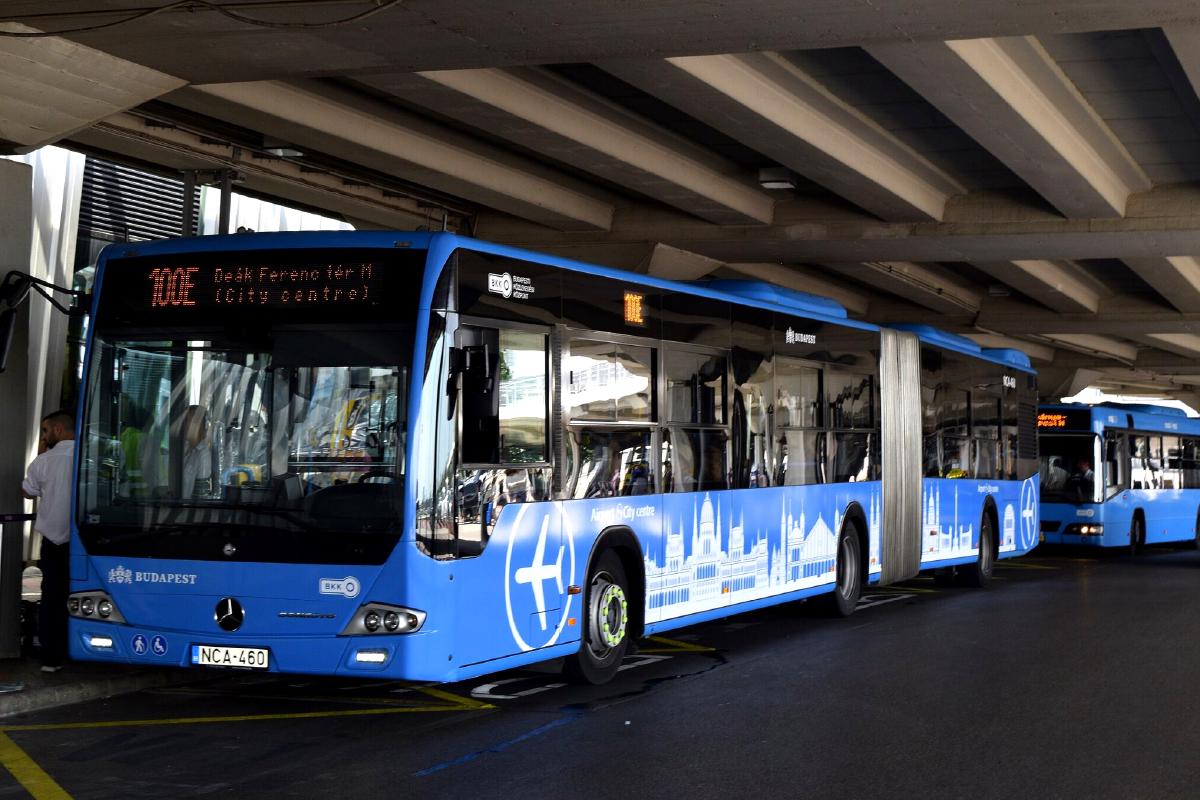
The 100E Airport Express is a non-stop BKK bus from Terminal 2 to the centre of Pest, running 24 hours a day with a special 2,500 HUF ticket. The stop is on the arrivals level, between Terminals 2A and 2B, and it’s signposted from both.
Stops towards the city: Kálvin tér (metro M3 and M4), Astoria (M2) and Deák Ferenc tér (M1, M2, M3), the end of the line (bud.hu). All three are a short walk or one metro ride from most central hotels.
Frequency: every 6–10 minutes on weekday daytimes, 7–10 minutes at weekends, 10–15 minutes early and late, and every 30–40 minutes on average at night, according to BKK. BKK quotes 40 minutes for the journey. It’s usually a little quicker outside rush hour.
The ticket rules that catch people out:
- A normal 500 HUF single ticket is not valid on the 100E.
- The 24-hour and 72-hour Budapest travelcards are not valid on it either (BKK).
- Holders of a monthly Budapest pass, the Pest County Pass or the Hungary Pass can buy a 1,000 HUF add-on ticket, but only in the BudapestGO app (BKK).
- You board at the front door only.
How do you pay for the 100E?#
You pay for the 100E by tapping a contactless bank card, phone or watch on the Budapest Pay&GO reader next to the door. It charges the standard 2,500 HUF, and one tap can buy up to five tickets for a group (BKK Pay&GO). If an inspector checks you, you tap the same card on their device.
The other ways to buy are the BudapestGO app, the ticket machines at the stop, and the BKK customer desks in the arrivals halls: Terminal 2A is open 8:00–22:00 and Terminal 2B 9:00–21:00 daily (BKK customer centres). If you’ll need a travelcard later, buy it at the desk now and save a queue in town.
Is the 200E bus and metro cheaper?#
Yes: the 200E bus plus the M3 metro costs 1,000 HUF with two single tickets, 850 HUF with an app ticket, or nothing extra if you already have a 24- or 72-hour travelcard. It takes longer, about 45–55 minutes to the centre, with a change.
The 200E runs from Terminal 2 to Kőbánya-Kispest, the end of the M3 metro line, and on to the centre from there (Kálvin tér, Ferenciek tere, Deák Ferenc tér). It accepts ordinary BKK tickets and travelcards, but not the 100E ticket (bud.hu).
The ticket catch: a single ticket doesn’t allow a change from bus to metro, so you need two singles (500 HUF each, bought in advance). The 90-minute ticket (850 HUF) covers both, but it’s sold only as a mobile ticket in the BudapestGO app (BKK). The simplest way without the app is a paper single for the bus, then a Pay&GO tap of your bank card at the M3 gate at Kőbánya-Kispest.
Verdict: worth it with a travelcard, not worth it to save 1,500 HUF with a big suitcase. The 100E has luggage space and goes straight to the centre.
What about the train?#
There’s no direct rail link to the terminal. The 200E stops at Ferihegy railway station, next to the old, closed Terminal 1, where MÁV trains run to Nyugati station, which bud.hu puts at 30 minutes to the centre (bud.hu). The station has no ticket office, only platform machines, and train tickets aren’t sold at Terminal 2. BKK’s 24- and 72-hour travelcards are valid on MÁV trains within Budapest (BKK).
It’s only worth the change if you hold a travelcard and your hotel is near Nyugati. A new airport rail line is planned: the government published the tender in January 2026, with completion targeted around 2035.
How much is a taxi from Budapest airport?#
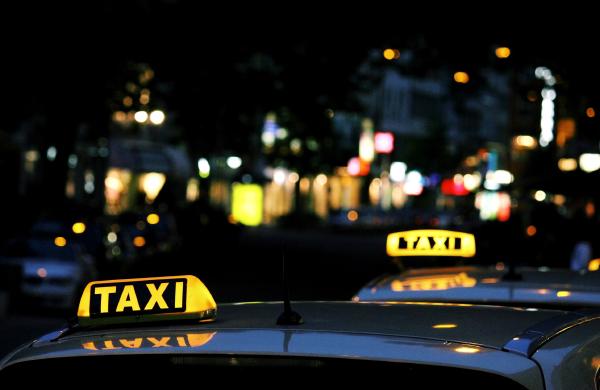
A taxi from Budapest airport to the city centre costs roughly 13,000–16,000 HUF (about €36–44), depending on your address and the traffic. Budapest taxi fares are regulated, and from 1 August 2026 the airport fare is a 2,100 HUF base fare, plus 520 HUF per kilometre and 130 HUF per minute when the car moves slower than 15 km/h (BKK taxi services). The fare is the same day and night, and for every licensed company.
Főtaxi is the airport’s contracted taxi company. Go to the Főtaxi stand at the exit of Terminal 2A or 2B, give your address, and they’ll prepare a fare estimate before the trip. Every car takes cards (bud.hu). There are no fixed zone prices: the meter decides.
Uber and Bolt both work. Uber came back to Budapest in June 2024 as Uber Taxi, which sends licensed yellow taxis at the regulated fare. At the airport, the app gives you a 6-digit PIN: walk to the Uber pickup point in front of Terminal 2A, take the first car and give the driver the PIN. Uber XL (up to six people) picks up at Terminal 2B (bud.hu). Bolt is also a licensed Budapest taxi operator; its pickup point can change, so follow the app (Bolt).
Is it worth it? For one or two people, no: two 100E tickets cost 5,000 HUF. For three or four people going to one address, a taxi at about 13,000–16,000 HUF works out at roughly 3,300–5,300 HUF a head against 2,500 on the bus, and it’s door to door.
Should you book a shuttle or private transfer?#
Book a shuttle or private transfer only if you want someone waiting with your name, or door-to-door travel without a taxi queue; on price, the 100E and a taxi usually win.
miniBUD is the airport’s official shared shuttle: a minibus that drops each passenger at their own address, with one large and one small bag per person. Budapest Airport lists it from 2,499 HUF per person (bud.hu). The price depends on your address, so check miniBUD’s own site too. The same service is sold on GetYourGuide with free cancellation:
Budapest: Shared Airport Shuttle Bus Transfer (miniBUD)
The official miniBUD shuttle, one way or return, with departures every 15–25 minutes according to the listing. Validate the voucher at a miniBUD information point in the baggage hall of Terminal 2A (or next to the Tourism Office) or 2B (or next to the Spar). Free cancellation up to 24 hours before. Best for solo travellers with a hotel away from the metro.
For a private car, two GetYourGuide options are worth a look:
Budapest Private Airport Transfer (Cityrama)
A private car, minivan or minibus with an English-speaking driver who meets you outside customs, priced per group of up to three (4.6 from 284 reviews). Gratuities are included. Worth it for a family arriving late, but compare with a taxi first.
View Tour →BUD Airport Private Transfer Service In or Out (Program Centrum)
A private car priced per group of up to two (4.9 from 15 reviews), with airport parking fees included and service round the clock. Few reviews so far, so treat the rating as early.
View Tour →For the rest, see all Budapest airport transfers on GetYourGuide.
How do you get from the airport to the city at night?#
At night, take the 100E Airport Express: it runs all night, roughly every 30–40 minutes, and still drops you at Kálvin tér, Astoria and Deák Ferenc tér. The 200E also runs all night, but the metro stops at about midnight on weekdays and 1:00 at weekends. After that, the night 200E is extended to Határ út (M3) to meet night buses (bud.hu).
The night-bus network was reorganised from 1–2 July 2026, and older guides list line numbers that have changed, so plan the last leg in the BudapestGO app (BKK night services). On night buses you can buy a 700 HUF single from the driver. Taxis, Uber and Bolt run all night at the daytime fare.
Is the Budapest Card valid on the airport bus?#
Only the 72-hour Budapest Card Plus (39,990 HUF) includes the 100E, as one round trip; the Classic Budapest Card doesn’t cover it (BKK). Classic cards do cover the 200E and the M3 like any travelcard. Whether the card pays off depends on what you’ll visit, and our Budapest Card maths works it out.
How do you get back to the airport?#
The 100E back to the airport leaves from Deák Ferenc tér, then stops at Kálvin tér. It also calls at Astoria, but only between 00:04 and 04:47 (bud.hu), so in the daytime board at Deák or Kálvin tér.
Budapest Airport advises arriving about two hours before departure. Check-in closes 30 minutes before (40 minutes for low-cost airlines) (bud.hu). Allow extra if you’re a non-EU traveller leaving the Schengen area: the EU Entry/Exit System has been rolling out at BUD since November 2025 and can slow passport control.
Leaving your bags: the airport’s baggage storage is open 6:00–22:00 daily and costs 2,750 HUF per item for up to 4 hours (bud.hu). If you have a long layover, our one-day Budapest guide has a timed route from the 100E.
Money at the airport: cash, ATMs and exchange#
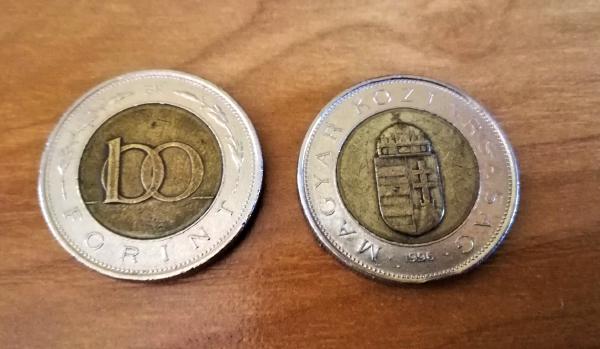
You don’t need forints to get into town: the 100E, the metro gates, taxis, Uber and Bolt all take cards. If you want cash, use a bank-branded ATM rather than a currency-exchange kiosk, and when a card machine or ATM offers to charge you in your home currency, decline and pay in HUF. That “conversion” is almost always the worse rate. More on this in our guide to Budapest currency and tipping.
Where to stay near the 100E#
Every 100E stop is in the middle of things. Kálvin tér is next to the budget hotels and hostels of District IX, Astoria is on the edge of the Jewish Quarter, and Deák Ferenc tér is the centre of District V. See where to stay in Budapest for the areas and our budget hotels and hostels guide for cheap beds near Kálvin tér. For getting around once you’re in town, see our Budapest public transport guide.
Who should skip the 100E?#
Skip the 100E if you already hold a 24- or 72-hour travelcard (take the 200E and M3), if you’re three or four people heading to one address with luggage (a taxi costs only a little more per head), or if your hotel is in Buda, where the bus drops you on the wrong side of the river. For everyone else, it’s the right answer.
FAQ#
How do I get from Budapest airport to the city centre?#
Take the 100E Airport Express bus from Terminal 2. It runs 24 hours a day to Kálvin tér, Astoria and Deák Ferenc tér, costs 2,500 HUF (about 7 euros) and takes about 40 minutes. You can pay by tapping a bank card on board. A taxi costs roughly 13,000 to 16,000 HUF to the centre.
How much is the 100E bus from Budapest airport?#
A 100E Airport Express ticket costs 2,500 HUF (about 7 euros) one way, as of September 2026. Normal single tickets and 24- and 72-hour travelcards are not valid on it. Monthly and county pass holders can buy a 1,000 HUF add-on ticket in the BudapestGO app.
Can you pay by card on the 100E bus?#
Yes. Tap a contactless bank card, phone or watch on the Budapest Pay&GO reader by the door of the 100E, and it charges the normal 2,500 HUF fare. One tap can buy up to five tickets. You can also buy in the BudapestGO app, from ticket machines or at the BKK desks in the terminal.
How much is a taxi from Budapest airport to the city?#
A taxi from Budapest airport to the city centre costs roughly 13,000 to 16,000 HUF (about 36 to 44 euros), depending on the address and traffic. Since 1 August 2026 the regulated airport fare is a 2,100 HUF base fare plus 520 HUF per kilometre and 130 HUF per minute in slow traffic. That is our estimate from the official tariff.
Is there Uber in Budapest?#
Yes. Uber returned to Budapest in June 2024 as Uber Taxi, which sends licensed yellow taxis at the regulated fare. At the airport, Uber gives you a 6-digit PIN and you take the first car at the Uber pickup point in front of Terminal 2A. Bolt also works at the airport.
How do you get from Budapest airport to the city at night?#
The 100E Airport Express runs all night, roughly every 30 to 40 minutes, and is the easiest option. The 200E bus also runs all night, but after the metro closes it goes to Határ út to meet night buses. Taxis, Bolt and Uber work around the clock at the same fare as by day.
Is the Budapest Card valid on the airport bus?#
Only the 72-hour Budapest Card Plus (39,990 HUF) includes a 100E round trip. The Classic Budapest Card does not cover the 100E, but it does cover the 200E bus and the M3 metro, as ordinary travelcards do.
How early should I get to Budapest airport?#
Budapest Airport advises arriving about two hours before departure, and check-in closes 30 minutes before departure (40 for low-cost airlines). Allow more if you are a non-EU passport holder leaving the Schengen area, because the new EU Entry/Exit System can slow passport control.
Last verified: 16 October 2026. Prices and timetables change, so confirm with the operator before booking.